Solution • Multiphysics digital twin • AI-native
TerraNavitas Subsurface Simulator
Physics-first modeling for geothermal, CO₂ storage, and unconventional reservoirs—built to turn ensembles into defensible decisions, not just pretty plots.
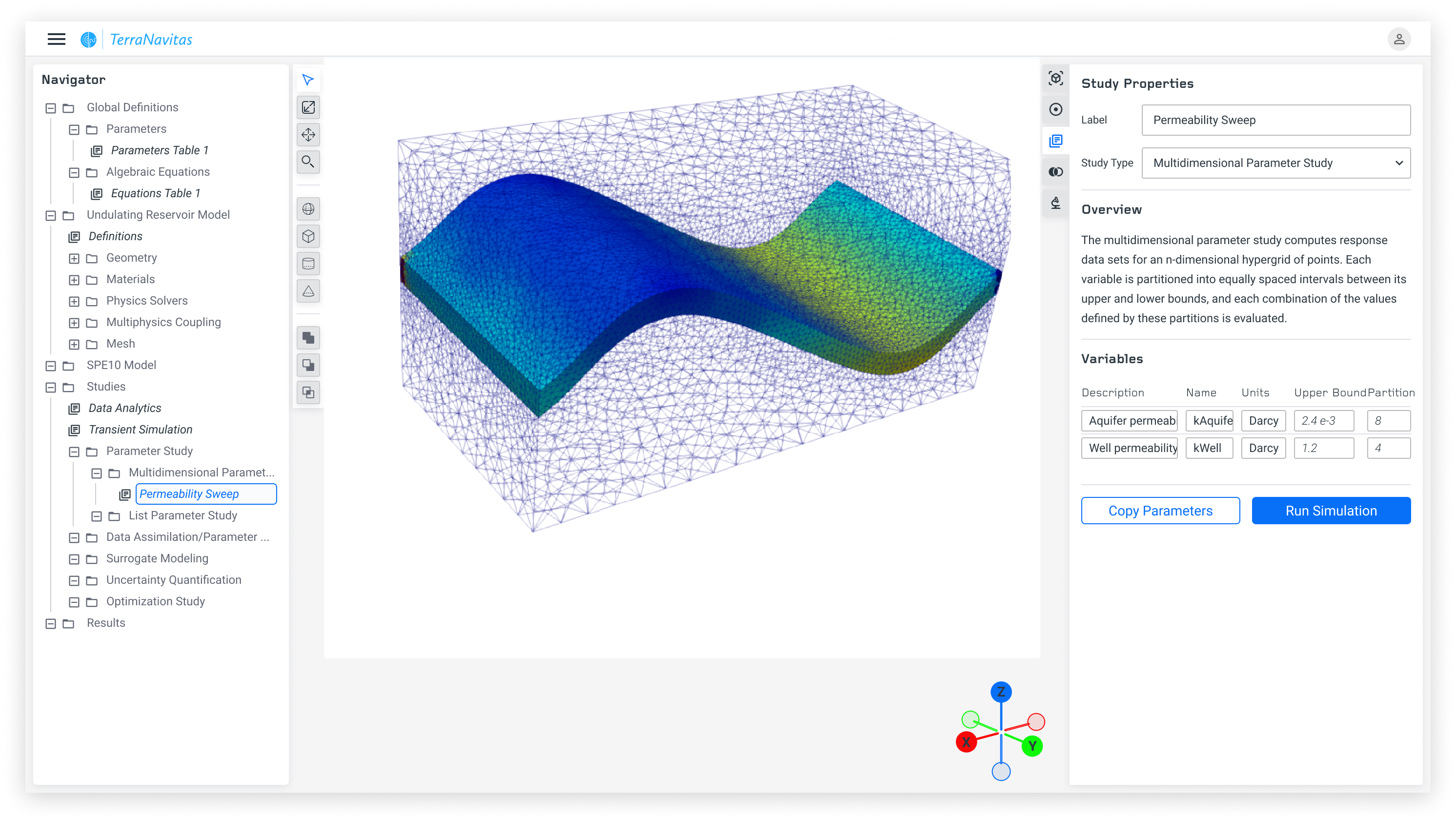
Interactive workflow UI
Build → run → quantify uncertainty → publish decision surfaces.
Capabilities
From subsurface physics to decisions you can defend
The platform is designed to make advanced simulation usable: a guided workflow UI, scalable execution, and UQ patterns that turn uncertainty into a decision surface.
Field-scale multiphysics that stays grounded
Simulate coupled subsurface behavior (flow, heat, mechanics, chemistry) with a national-lab multiphysics core plus MFEM-based proprietary mechanistic models.
Engine
National-lab multiphysics core + MFEM
UQ
Screen → Surrogate → Propagate
Delivery
Web UI + scalable execution
Workflow
A guided path from concept to publishable model
The platform is designed around a practical, end-to-end workflow: define the model, run at scale, then package results into decision surfaces your team can reuse.
Active step
Model environment
Define goals, constraints, and operational levers so every run is traceable to a decision.
UI structure
- Navigator panel for workflow context
- 3D viewport + interaction controls
- Properties pane for configuration
- Libraries for materials/physics presets
Designed for UQ
- Parameter ranges built in—not bolted on
- Screening before expensive ensembles
- Surrogate fit + validation patterns
- Forward propagation to decision surfaces
Publishable by construction
Package inputs, versions, outputs, and objectives so the team can reproduce results and reuse models across scenarios (and stakeholders can follow the logic).
UQ
Uncertainty turns into a decision surface
The UQ protocol is simple “cookbook”: define the objective, screen inputs, fit surrogates, then propagate uncertainty forward—so stakeholders see risk, not just a single run.
Toolkit patterns
Dakota-style ensembles + sensitivity workflows
Surrogates
Response surfaces + physics-informed ML
Outputs
Tradeoffs, constraints, confidence intervals
The protocol
(practical, not academic)
Step 01
Objectives + constraints
Start with what matters: target outputs, constraints, operating envelopes.
Step 02
Survey the uncertainty
Identify uncertain parameters and prior ranges; focus effort where it changes decisions.
Step 03
Sensitivity + screening
Screen early to reduce dimensionality before expensive sweeps.
Step 04
Surrogate construction
Fit validated surrogates to accelerate exploration and enable ensembles.
Step 05
Forward propagation
Run ensembles through the surrogate (and select high-fidelity confirmations) to reveal risk.
Why this matters
Subsurface decisions are coupled and nonlinear—UQ provides a defensible explanation of risk and tradeoffs, not just a best-guess forecast.
Architecture
Designed for scalable simulation services
A clean UI front-end feeds a workflow engine that can run locally, on a cluster, or in the cloud—while keeping data and provenance organized for collaboration and reuse.
Service layout
UI → API → orchestration → compute → storage. Message-driven execution keeps runs trackable and resilient.
Pair with ODIS for a unified oilfield data backbone, or feed outputs into the Critical Minerals platform for subsurface-informed exploration.
Web UI
- Workflow navigator
- 3D viewport
- Properties & libraries
- Results dashboards
API + Orchestration
- Job lifecycle
- Queues / messages
- Provenance artifacts
- Scenario management
Compute + Storage
- Distributed execution
- Ensembles
- Model/result storage
- Surrogate registry
User experience
Navigator + 3D viewport + properties + libraries
Orchestration
Job lifecycle, queues, provenance, repeatability
Compute layer
Distributed runs, ensemble execution, HPC patterns
Data layer
Model inputs + results storage designed for large outputs
Security posture
Workspace-ready controls (RBAC-friendly patterns)
Deployment flexible by design
Use cases
Built for subsurface energy systems
The core workflow generalizes: define the decision, simulate coupled physics, quantify uncertainty, then publish decision surfaces teams can act on.
Geothermal (EGS + next-gen systems)
Plan stimulation, manage thermal drawdown, and evaluate long-horizon performance under uncertainty.
CO₂ storage & subsurface decarbonization
Quantify plume migration, pressure management, and containment risk with scenario ensembles.
Unconventional reservoirs
Model coupled flow + geomechanics + fracture effects and turn results into actionable development decisions.
Field development decision surfaces
Convert simulation campaigns into fast trade-space exploration dashboards for technical and executive stakeholders.
Moat
Mechanistic rigor, accelerated
Our differentiation is not “a simulator.” It’s a productized, decision-oriented workflow that fuses mechanistic solvers, UQ protocols, and surrogate acceleration into one repeatable system.
IP-aligned workflow components
The provisional patent claims emphasize a digital-twin workflow that couples mechanistic modeling with uncertainty, calibration-ready steps, and decision-focused outputs.
Mechanistic core
- Governing equations solved with modern numerical methods
- Proprietary mechanistic models built with MFEM
- Guardrails that keep ML physically plausible
Decision outputs
- Decision surfaces and tradeoff frontiers
- Scenario packaging + provenance for reuse
- Risk-aware recommendations (UQ-driven)
Also from TerraNavitas